The Lantern of the Sugar-Palm Village
March 16, 2026
March 16, 2026
Long ago, between two green kingdoms, there was a quiet place called Sugar-Palm Village. The houses were small, the hearts were big, and every night the villagers hung little lanterns made from palm leaves to guide travelers home.
In that village lived a boy named Dara, who could hear the “language of wind.” When the wind was happy, it whispered like a flute. When the wind was afraid, it scratched the bamboo like claws.
One afternoon, the wind changed.
It did not sing.
It warned.
“Dara… Dara… hide the children…”
Dara looked toward the border road and saw dust rising like a brown cloud. In the cloud were soldiers from the far side—helmets shining, eyes sharp, hunger sitting on their shoulders like invisible birds.
The village elder, Ta Vannak, rang the bell of the spirit-house.
“Close your doors,” he said. “Put out your cooking fires. Fear loves smoke.”
Mothers gathered children. Old men carried jars of water. Dogs stopped barking as if even they understood the danger.
Dara’s mother, Srey Neang, grabbed his wrist.
“Stay behind me,” she whispered.
But Dara slipped away and ran to the shrine where the village lanterns were kept. He took the smallest one—woven from palm leaf, with a flame so gentle it looked like a firefly trapped in a cup.
“Grandmother always said,” Dara murmured, “a lantern can soften a tiger.”
The Soldiers and the Shadow-Curse
As the soldiers entered the village, a strange thing happened: their shadows grew long and heavy, crawling across the ground like dark snakes.
Because it wasn’t only men who came that day.
A Shadow-Curse traveled with them—born from old anger, old pride, and old stories people told when they forgot to see each other as human.
The curse whispered into ears:
“Take more.”
“Trust no one.”
“Crush first, or be crushed.”
Some soldiers kicked open baskets, searching for rice. Some shouted. Some raised their hands too quickly.
The Shadow-Curse smiled.
The Boy Who Offered Water
Dara stepped forward, holding the palm-leaf lantern in one hand and a clay cup of water in the other.
The soldiers froze. A child was not supposed to step into fear like that.
Their leader, a young lieutenant named Chai, stared at Dara as if the wind had slapped him awake.
Dara lifted the cup.
“Sir,” he said politely, voice shaking but steady, “the road is long. Water helps the heart remember itself.”
Lieutenant Chai blinked. His own shadow twitched like it wanted to bite.
“Why would you offer me kindness?” he asked.
Dara pointed at the lantern.
“My village makes lanterns for travelers,” Dara said. “Even if travelers come… with thunder in their hands.”
For a moment, the Shadow-Curse hissed. It hated those words.
But Lieutenant Chai took the cup and drank.
And when he did—his shadow shrank. Just a little.
When the Curse Tried to Win
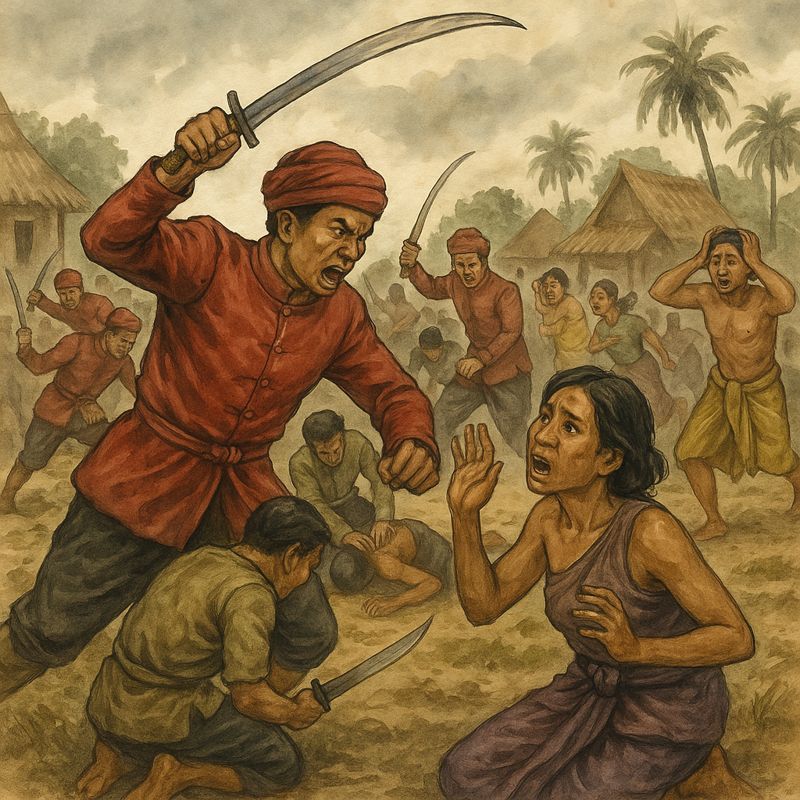
A rough soldier grabbed a villager’s sack and shoved an old man aside. The old man fell to the ground. Children cried out.
The Shadow-Curse grew excited, swelling like smoke.
“More!” it whispered. “Break them!”
Srey Neang ran forward, trembling.
“Please,” she begged. “We are farmers. Not enemies.”
The rough soldier lifted his hand again—
Then the palm-leaf lantern in Dara’s hand flared bright.
Not like a weapon.
Not like fire.
Like truth.
The light spilled onto the soldier’s shadow… and the shadow revealed what it really was: a twisted shape made from fear, not courage.
The soldier jerked back, startled by his own darkness.
Lieutenant Chai stepped forward, voice sharp as a temple bell.
“Enough!” he commanded. “No one touches civilians.”
The Shadow-Curse screamed silently, angry that someone had said the one word it could not stand.
Stop.
The Bargain Under the Banyan Tree
That night, Ta Vannak invited the lieutenant to meet at the ancient banyan tree—the one said to have roots deep enough to drink from tomorrow.
Dara carried the lantern between them.
Ta Vannak spoke first.
“War makes hungry mouths,” he said gently. “But hunger is not permission to become a monster.”
Lieutenant Chai looked down.
“I lost family,” he admitted. “Anger followed me here like a dog.”
Dara raised the lantern.
“Then let it follow you home,” Dara said, “not into other people’s houses.”
A long silence.
Then Lieutenant Chai did something no curse ever expects.
He apologized.
And Ta Vannak did something pride never expects.
He forgave.
They made a simple agreement:
the village would give water and a small portion of rice,
the soldiers would leave civilians unharmed and move on,
and anyone who tried to break this promise would answer not to men—but to the banyan tree’s spirits.
The Lanterns on the River
Before dawn, the villagers floated lanterns on the river—one for fear, one for grief, one for hope.
As Dara placed his lantern onto the water, Srey Neang touched his shoulder.
“You were brave,” she said.
Dara shook his head.
“I didn’t fight,” he whispered.
His mother smiled softly.
“Bravery is not always a fist,” she said. “Sometimes it is a light.”
And the wind returned to singing.
Not because the world became perfect,
but because one village remembered:
A lantern cannot stop every storm—
but it can stop the storm from living inside your heart.